A child’s zip code should never limit their opportunity
The ACCESS Act
Share
The Problem:
All across the country, parents are running into the same wall. A great public school sits just a few miles away, and their child is locked out of it for one reason: their address.
For decades, public schools have promised to be “available to all on equal terms,” as the Supreme Court affirmed in the landmark Brown v. Board of Education. The reality is different. Today’s school attendance boundaries too often trace the same lines as the racist redlining maps drawn in the 1930s, turning educational redlines into a quiet engine of racial and economic segregation. In many communities, buying into a coveted school zone costs an extra $200,000 or more in home prices, putting what should be a free public education out of reach for working families. Some districts charge out-of-zone families anywhere from $5,000 to over $20,000 a year to attend. And families who try to slip past those lines by using a relative’s address, for instance, have faced fines, private-detective investigations, and even jail.
A great school should not come with a downpayment. This country is built on the premise of a free, high-quality public education, but most families can’t access it without a real estate agent.
What the ACCESS Act Does:
The Advancing Choice in Education for Student Success (ACCESS) Act was introduced by Senator Ashley Moody (R-FL), Senator Michael Bennet (D-CO), and Senator Tim Scott (R-SC). It amends the Elementary and Secondary Education Act of 1965 (ESEA) to break the link between where a child lives and the public school they’re allowed to attend, starting with the students who need it most.
The bill:
- Guarantees an exit from failing schools. Any student in a school identified for Comprehensive Support and Improvement (the lowest-performing tier) has the right to transfer to a better-performing public school in their district.
- Encourages open enrollment. States and districts are encouraged to let all families enroll across boundary lines, both within and between districts.
- Invests in real options. Families should be able to choose from a variety of high-quality public schools so that they can find the right fit for their child, including magnet schools, innovation schools, charters, career academies, early college, and apprenticeships.
- Breaks down the barriers to choice. Choice only works if families are empowered to use it. The ACCESS Act eliminates tuition charges for public schools, ends the civil and criminal penalties families face for crossing boundary lines, invests in transportation so a seat actually comes with a ride, and incentivizes simple enrollment systems under one unified application platform.
It does all of this while preserving critical guardrails: the bill explicitly bars discrimination by race, color, religion, sex, national origin, or disability, upholds Section 504 protections, and ensures no current student is displaced.
Why Federal Action Is Needed:
The demand is already here; the system just won’t meet it. According to the National Center for Education Statistics, one in five public-school families already leaves their neighborhood to attend a school of their choice, and many more would if the door were open. But the door is mostly shut: only 16 states require all districts to take part in cross-district open enrollment, and only 13 require it within districts.
Where states have opened that door, the results are real. A 2023 study of Los Angeles found that as public-school options expanded, both student achievement and college enrollment rose – with the biggest gains in the lowest-scoring schools, and improvements for students who switched schools as well as those who stayed put. Meanwhile, in Denver, more than 80% of families take part in a universal choice system, and the district’s fourth-grade NAEP reading scores rose seven points in 2024 compared with other large cities.
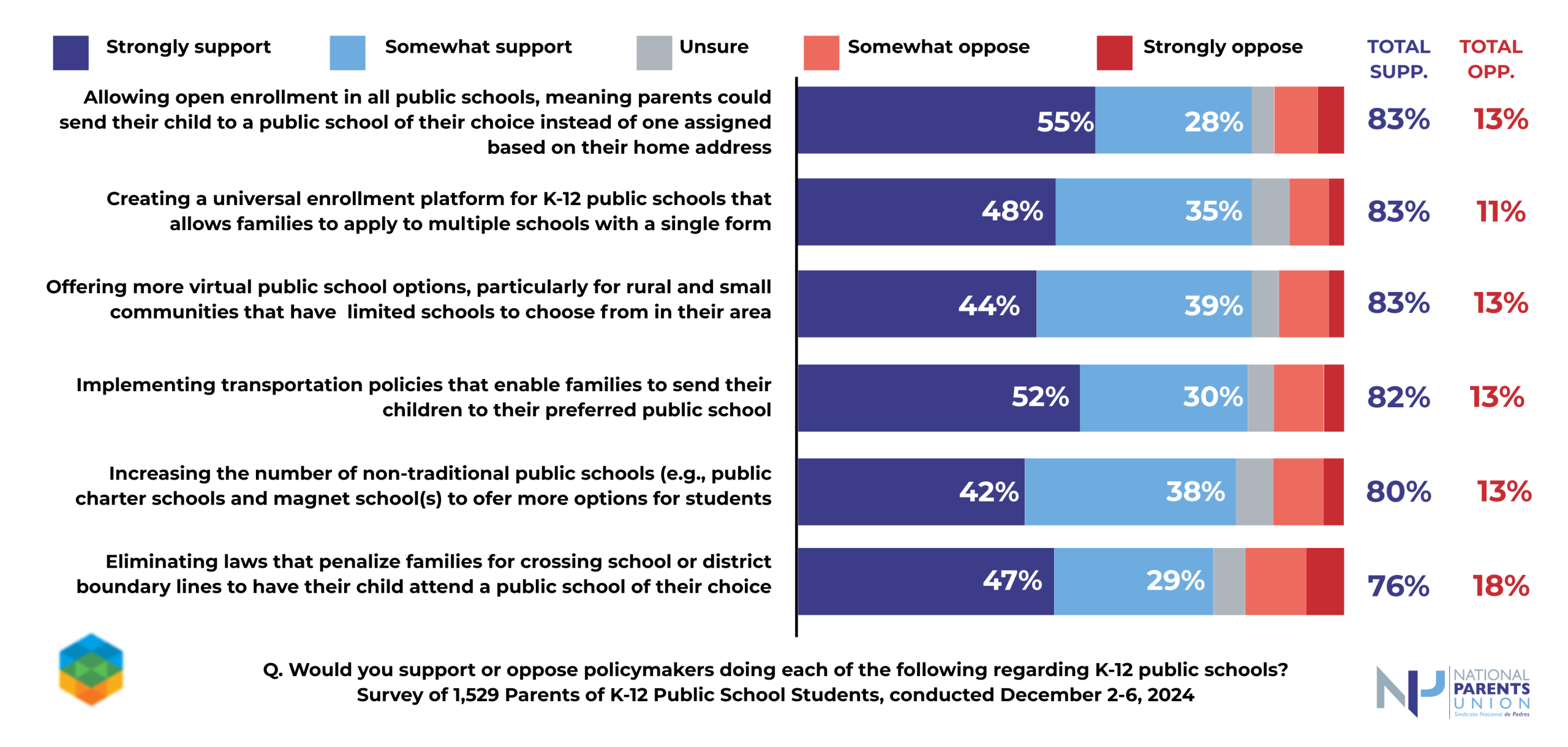
And this is exactly what parents want. NPU polling shows strong support across party lines:
The Future We’re Building:
Picture an education system built for the kid in front of you, not the segregationist lines on a map. A child can attend the dual-language school that’s just a few miles past the one next door. A family raising a future nurse can reach a career academy. An aspiring engineer can start at an early college program and bank real college credit before graduation. A family stuck in a school that has failed them for generations can finally walk into the better one just down the road. And a family that loves their neighborhood school? They can stay right where they are. That’s the beauty of ACCESS: public options, accessible to every family, so that every child has the opportunity to thrive.