Funding Uncertainty for Schools on the Horizon
Share
By Rianna Saslow, Deputy Director of Policy at National Parents Union
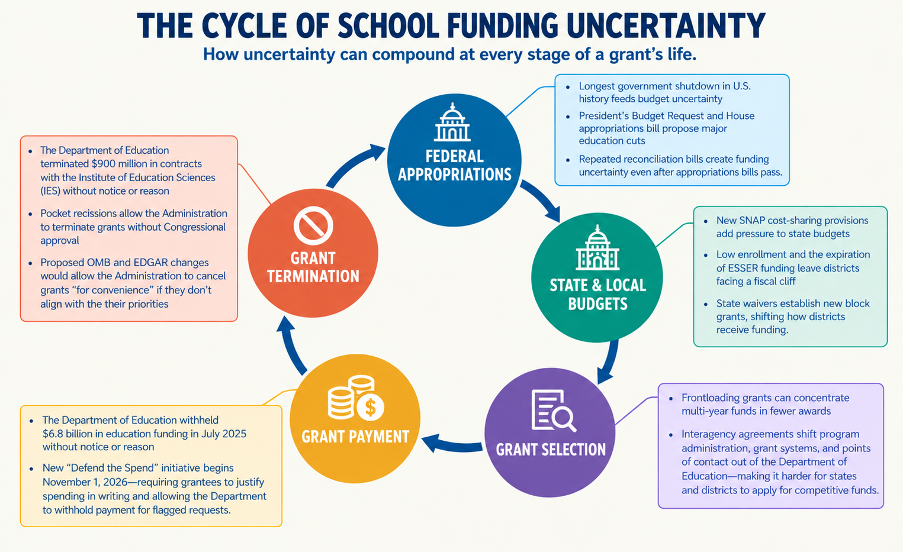
For America’s schools and families, the past two years have been plagued with uncertainty. Last summer, the Trump Administration abruptly withheld approximately $6.8 billion in education funding that Congress had already appropriated. A series of interagency agreements shifting functions out of the Department of Education have changed grant administration, systems, and points of contact. Meanwhile, recissions, reconciliation legislation, the expiration of pandemic-era block grants, and new state fiscal pressures (including SNAP cost-sharing obligations) have compounded uncertainty for education budgets. Not to mention, every appropriations cycle brings another round of proposals for major cuts to public education.
In short, schools can no longer count on the money they’ve been promised from the federal government, and over the next year, there is potential for this to get significantly worse.
Districts must make staffing, programming, and instructional decisions without knowing if or when funds will arrive, which agencies will administer them, what requirements will apply, or whether a grant will continue for its intended duration. This uncertainty makes it harder to hire educators, sustain services for families, and plan beyond the next budget cycle.
Our nation’s government rests on the separation of powers. One of Congress’s most essential roles is to determine how federal funds are appropriated and establish the purposes for which they may be spent. The executive branch is responsible for administering those funds in accordance with the law, not making their own determinations about whether those investments are worthwhile. This is a fundamental question of whether Congress still controls the federal purse that has been Constitutionally granted to them.
In May, the Office of Management and Budget (OMB) proposed sweeping changes to requirements and regulations governing all federal grants. The proposed rule would vastly expand executive discretion over grants and allow agencies to terminate awards when they no longer align with the current administration’s policies and priorities.
The proposed OMB rule drew overwhelming pushback across sectors, with nearly 500,000 public comments submitted – most of them opposing the changes. Senator Collins (R-ME), Chair of the Appropriations Committee, spoke out against the proposed rule, and bipartisan efforts temporarily barred it from taking effect until December as part of the latest continuing resolution.
Unsurprisingly, the Administration hasn’t taken no for an answer. A proposed rule under the Department of Education mirrors many of the changes proposed by OMB, stating that the Department may at any point terminate a discretionary grant “for convenience.”
This leaves district programming vulnerable to the politicization of their grants, and the implications are huge. A termination standard tied to shifting executive priorities would let agencies end multi-year awards funded by Congress, effectively allowing the Administration to refuse appropriations without a formal rescission process. This leaves schools, universities, and other grantees unable to rely on previously awarded funds for long-term projects and services, and it makes it impossible to plan initiatives spanning multiple administrations who may have drastically different priorities.
And the overreach continues. Beginning November 1, 2026, the Department of Education will also roll out their new “Defend the Spend” initiative, which will require every grantee to justify their spending in writing. In just 255 characters, every recipient spanning from early childhood to K-12 to adult education will have to identify the grant program, expense categories and amounts, and the date range of the expenses. The Department may withhold payment on any flagged requests until it accepts the grantee’s explanation.
Meanwhile, the Department of Education is operating on a skeleton crew following a series of RIFs. Payment delays are likely if and when requests accumulate faster than remaining staff can process them. And grantees will be expected to navigate new requirements with multiple grant platforms across multiple agencies, with multiple sets of conflicting guidance. When payments stall, districts must front the cost of special education services, Title I supports, and other education programs – if they can afford to. Otherwise, educators and families will lose access to these services without notice.
Swamping both school districts and the Department of Education itself with unnecessary compliance exercises and paperwork runs contrary to the Administration’s own goals of cutting red tape, reducing bureaucracy, and shutting down the Department altogether.
Instead of streamlining government, these policies show a troubling pattern of executive overreach, and they undermine the lawmakers who are actually responsible for deciding how taxpayer dollars are spent.
But the most devastating consequences are felt far beyond Washington. When the Administration withheld $6.8 billion in education funding last July, schools were forced to abruptly cancel summer learning programs, leaving parents scrambling for childcare and children without the extra instruction they needed to catch up. The cancellation of $900 million in contracts with the Institute of Education Sciences halted research already underway, wasting years of investment and delaying the discovery of much-needed solutions to help students learn. Just last month, the termination of federal special education grants threatened critical services for deafblind children, including parent-to-parent support programs that help families understand and meet their children’s needs, as well as access to specialized educators and direct services. And with more sweeping changes from OMB and EDGAR on the table, educators are left wondering whether the funding that pays their salaries, supports their professional development, and sustains essential student services will actually arrive.
These are decisions that upend families, undermine schools, and leave children to bear the consequences as their education, well-being, and futures become political collateral.