Every Child, Every Teacher, Every Word: A National Call for Literacy Justice
Share
By Meghann Bierly
March 26, 2026
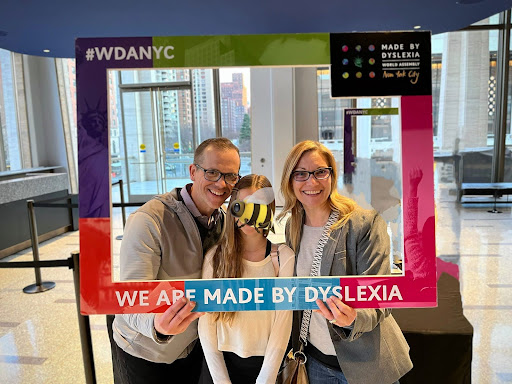
In a routine school meeting, an educator looked at me and said, “You need to get over your denial that your daughter has a disability and will always struggle.”
The remark was framed as candor. In truth, it reflected a ceiling already set on her future. That moment changed my role from “concerned parent” to full-time advocate not only for my child, but for every student with dyslexia whose abilities are quietly underestimated.
I am a certified school psychologist. For years, I sat at the table reviewing scores and helping teams decide on supports. Yet when it came to my own daughter, I didn’t know what I didn’t know, until what I did know didn’t work for her. The training and tools I’d relied on offered no roadmap to meet her needs.
Like many professionals supporting students, I had never been properly trained to identify dyslexia or to understand how the brain learns to read. Graduate coursework rarely covered the science of reading or the structured, explicit instruction proven to work. Those practices existed in journals and research centers—but hadn’t reached me, my colleagues, or my daughter’s classroom.
The consequences weren’t abstract. They played out in our family’s daily life. To access appropriate instruction and support privately, we reorganized everything: schedules, finances, routines. Over three years, the travel to and from alone added up to seventy‑one days 498 hours, nearly 30,000 minutes of our lives. For a middle schooler, that’s the time classmates spent in school from September through December. While they followed a normal rhythm, we rewrote ours to secure the education she deserved.
Those hours represent far more than time. They stand for emotional strain and the high price families pay for what public education should guarantee: a quality public education that is aligned with evidence‑based reading instruction. Our daughter knew she was capable of more. We knew she was capable of more. The research proves that almost all children can learn to read when given the right instruction. Yet her school refused to use what works.
Through this journey as a mother and a school psychologist forced to confront her own blind spots, I came to see our story as part of a systemic failure. The science of reading exists. The knowledge of dyslexia exists. Effective instruction exists. But these remain inaccessible to too many classrooms.
This isn’t about educators not caring. The professionals who worked with my daughter cared deeply. But care without training or systemic support is not enough. When preparation programs fail to teach future educators how to recognize dyslexia or use evidence‑based methods, we create a predictable cycle: students struggle, parents blame themselves, and educators misunderstand our children.
Our story could have ended there in quiet resignation. Instead, it became proof of what’s possible. With proper intervention and teachers who finally understood her needs, my daughter thrived. Her success is living evidence that what some called “lifelong struggle” was never about her ability, but the system’s unwillingness to learn what she needed and to act on what decades of research already show.
Yet I can’t ignore the cost. Not every family can rearrange its life to provide what schools inherently should. Not every parent can leave work early, pay for specialized instruction, or decode complex research on their own. When success depends on such sacrifices, we have built a system that privileges some children and abandons others.
Today, as both a parent and a professional, I see my responsibilities differently. It’s not only about my own child, but about the systems shaping every child’s opportunity. We need state and federal policies ensuring that the science of reading and knowledge of dyslexia are embedded in teacher preparation, professional development, and accountability frameworks. The expertise parents like me have had to seek privately, at great personal cost, must become standard knowledge for everyone entrusted with teaching children to read.
The comment that my daughter would “always struggle” was meant to end a conversation. Instead, it opened my eyes to how much we ask children to overcome when adults and systems refuse to learn. The research and tools exist. The question now is whether we have the will to ensure they reach every teacher, every classroom, and every child.
Meghann Bierly is a dyslexia parent, school psychologist, consultant, and parent advocate with more than two decades of experience in school and community settings, where she draws on both personal and professional experience to advance literacy in public schools. She is the Founder and CEO of Keel Services, READ 4 NJ, and READ 4 ALL, partnering with families to ensure that all children have the opportunity to grow, learn, and thrive. Beyond her professional roles, Meghann is deeply engaged in volunteer and community advocacy, collaborating with statewide and national organizations to advance literacy, strengthen special education services, and champion the belief that every child is capable of meaningful success. Connect with Meghann Bierly on Facebook, Instagram, and LinkedIn. Meghann is an active member of NPU’s Parent Power Collective.
###
ABOUT THE NATIONAL PARENTS UNION
With more than 1,800 affiliated parent organizations in all 50 states, Washington, D.C. and Puerto Rico, the National Parents Union is the united, independent voice of modern American families. We channel the power of parents into powerful policies that improve the lives of children, families and communities across the United States. https://nationalparentsunion.org/