Sound the Alarm: There’s a New School Police — and It’s AI Surveillance
Share
By Tammie Lang Campbell and Clarence Okoh
Let’s be clear: this is not a drill.
Right now, tech companies are quietly selling powerful AI surveillance tools to Houston-area schools. A team of technology and digital rights experts recently exposed how these schools are becoming “testing grounds” for controversial AI systems—impacting more than 1.3 million public school students.
That should stop all of us in our tracks.
Because what’s being built isn’t just “school safety.” It’s a digital version of the school-to-prison pipeline. And it’s happening in real time.
What Are We Really Talking About?
When people hear “AI in schools,” they might picture something harmless—maybe software that helps with grading or attendance.
That’s not what this is.
We’re talking about systems that can track students’ web searches, physical movements, social connections, and personal data. Some companies claim they can even measure emotions like aggression. Others are building predictive models using demographic data—race, disability status, disciplinary history—to “forecast” a student’s future.
Let that sink in.
Technology is being used to guess whether a child will go to college… or end up in prison.
Federal courts have already warned that surveillance technologies can easily trample our rights, exposing deeply personal details like political beliefs, religious affiliation, and even genetic information. Yet these tools are increasingly being normalized in public schools.
Millions for Monitoring — But Not for Support
Here’s what makes this even harder to accept: while districts are spending millions on experimental AI surveillance systems, many schools still struggle to fund basic needs.
We’re talking about:
- Not enough counselors
- Not enough teachers
- Not enough social workers
- School buildings with serious environmental issues, including black mold
Instead of investing in care, connection, and support, schools are investing in monitoring and punishment.
What message does that send to our kids?
When the Machine Gets It Wrong
The consequences aren’t theoretical.
Houston-area schools are using AI-powered vape sensors—devices with microphones and algorithmic detection systems placed in bathrooms and locker rooms. These systems gained traction after a 2023 Texas law mandated strict disciplinary placement for students caught vaping near school property.
In 2024, a Black student at Lamar Consolidated Fulshear High School was suspended after a vape sensor triggered an alert in a restroom. He wasn’t even inside when it happened. But because he couldn’t identify who was vaping, he was punished.
Think about that.
Disciplined by a machine.
Held responsible for something it couldn’t even prove.
In 2025, Houston ISD received more than $1.9 million for an automated weapon detection system—despite concerns about accuracy and civil rights violations. A similar system in Nashville failed to detect a handgun in a tragic school shooting.
These technologies promise safety. But when they fail, students carry the consequences.
This Isn’t Neutral — And It Never Has Been
We can’t ignore the bigger picture.
Black and Latino students are already disciplined at disproportionately higher rates—through suspensions, expulsions, referrals to law enforcement, and school-based arrests. When that historical data is fed into predictive AI systems, bias doesn’t disappear.
It gets automated.
The same inequities we’ve been fighting for decades risk becoming embedded in code.
If we don’t push back now, AI surveillance will quietly expand—tracking and punishing the same students who have always borne the brunt of over-policing.
So, What Do We Do?
First, we talk about it. Loudly.
Second, we organize.
We need what we call community firewalls—real, strategic protections against digital surveillance in our schools. That looks like:
- Showing up at school board meetings
- Asking hard questions about contracts and data privacy
- Demanding transparency
- Fighting for budgets that prioritize counselors over cameras
- Calling for bans on high-risk surveillance technologies
This isn’t about being anti-technology. It’s about being pro-children.
Our schools should be places where students feel safe enough to learn, make mistakes, and grow—not places where every movement is tracked and every data point is stored.
AI surveillance is the newest version of school policing. But it doesn’t have to be the future.
If we stay informed, stay engaged, and demand better, we can protect our children’s rights—and their opportunities.
The alarm is sounding.
The real question is: will we answer it together?
Watch a message from Tammie on AI surveillance here.
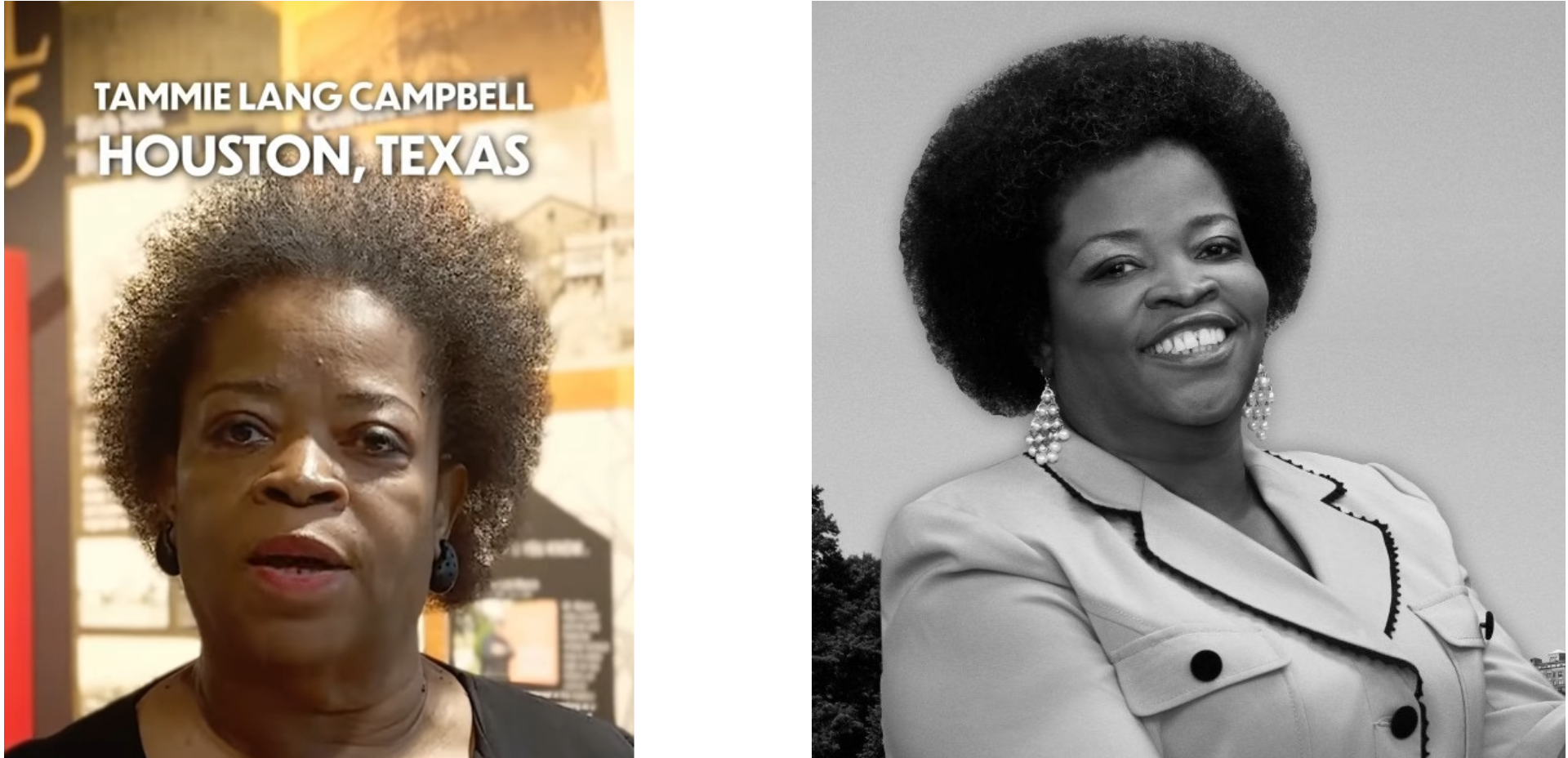
Tammie is a member of NPU’s Parent Power Collective and the recipient of NPU’s 2022 MVP Award for her three decades of service supporting youth and their families and addressing the school-to-prison pipeline locally and nationally.
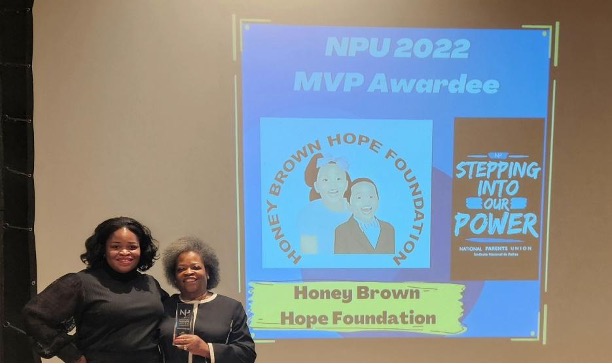
Tammie Lang Campbell accepting NPU MVP Award with Honey Brown Hope Foundation Communications Director, Shar-day Campbell.
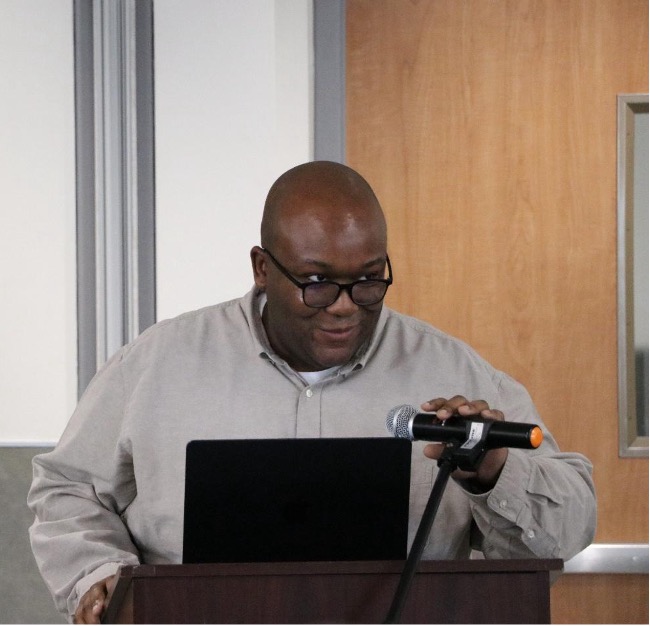
Clarence Okoh is a civil and human rights attorney at the Georgetown Law Center on Privacy & Technology. He is a co-founder of the NOTICE Coalition: No Tech Criminalization in Education. Clarence Okoh speaking at “The Impact of AI on Students, Education, and Privacy: A Black History Month” event in collaboration with Honey Brown Hope Foundation, No Data About Us Without Us (NDAUWU) Fellowship, NOTICE (No Tech Criminalization in Education Coalition), Edgelands Institute, Houston Community College, and ProConnect 7.
Tammie Lang Campbell is the founder/executive director of the Honey Brown Hope Foundation. Campbell created the “How to Advocate for Your Child: Toolkit for Black and Brown Parents and Guardians” to share with parents what she has learned from 30+ years of advocating for Black and Brown students derailed by the school-to-prison pipeline’s discriminatory discipline practices. She is a former branch president of the NAACP and NAACP Image Award-winning Activist; Resident Community Advocate for the Center for Justice Research at Texas Southern University; a No Data About Us Without Us Fellow; American Leadership Forum Senior Fellow; and Harvard University’s School-to-Prison Pipeline Roundtable Participant. Tammie is a member of NPU’s Parent Power Collective and the recipient of NPU’s 2022 MVP Award for her three decades of service supporting youth and their families and addressing the school-to-prison pipeline locally and nationally. Follow Honey Brown Hope on social media channels Facebook and Instagram.
###
ABOUT THE NATIONAL PARENTS UNION
With more than 1,800 affiliated parent organizations in all 50 states, Washington, D.C. and Puerto Rico, the National Parents Union is the united, independent voice of modern American families. We channel the power of parents into powerful policies that improve the lives of children, families and communities across the United States. https://nationalparentsunion.org/