By Kirby Rabalais
From Pain to Purpose. The Got4titude Story
Share
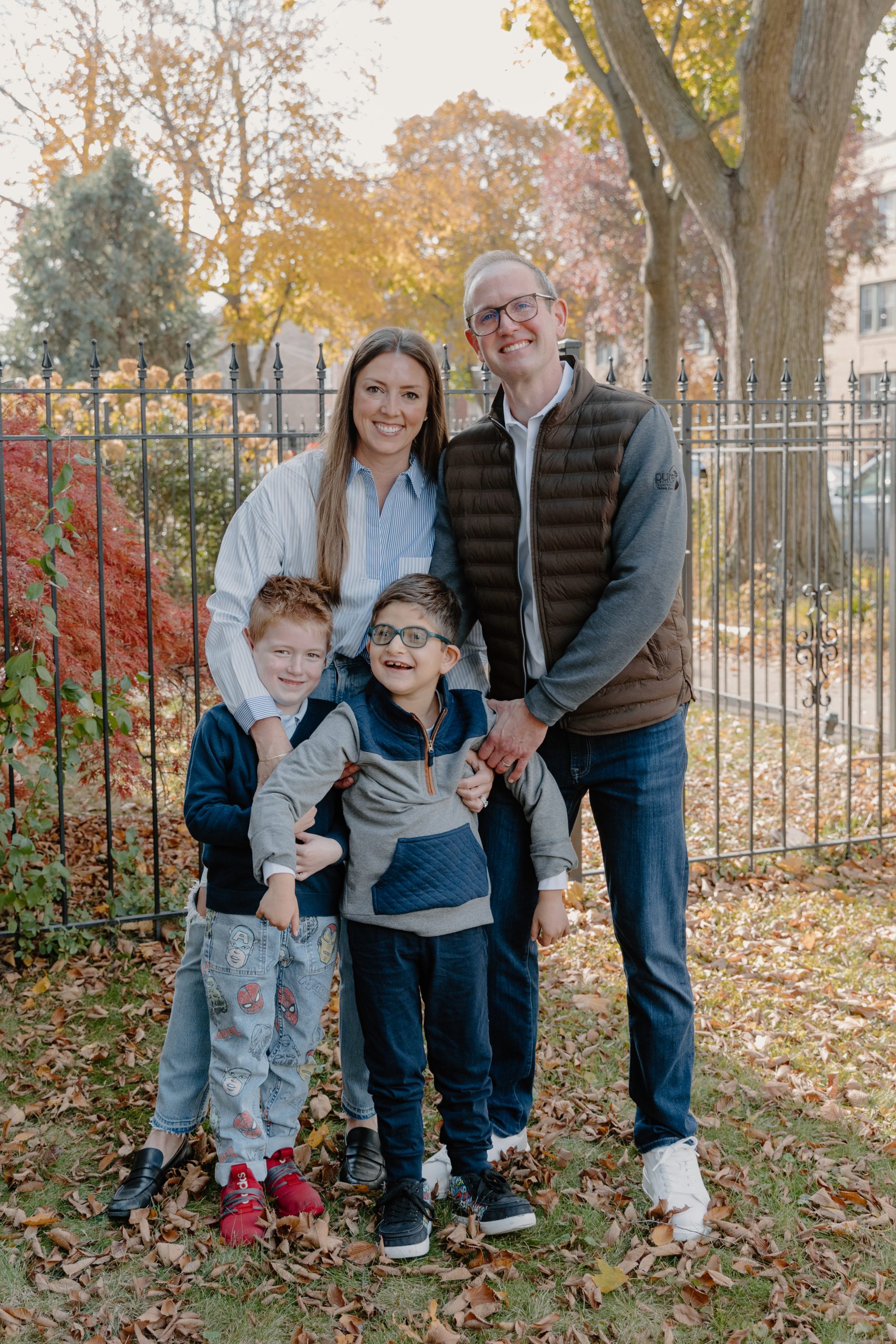
By Kirby Rabalais
There are moments in parenting that split life into a before and an after.
For my family, that moment came with my son Harley’s diagnosis. A rare genetic disorder that changed the trajectory of our lives in an instant.
I remember the weight of that season. The uncertainty. The questions that never seemed to end. The quiet fear that settles in when you realize the path ahead is not the one you imagined.
If you are a parent reading this, you already know the kind of love that shows up in those moments. It is fierce. It is protective. It is relentless.
It can also be isolating.
The part no one warned me about
Early on, I went into survival mode. I did what so many parents do. I tried to control everything.
I researched. I planned. I braced. From the outside, it looked like responsibility. On the inside, it was fear dressed up as control.
And underneath that fear was something I did not want to admit.
I was slipping into a victim mentality, and I was suffering in silence.
Why us?
Why him?
Why does it feel like everyone else is living a normal life while we are fighting for basic stability?
I carried anger. I carried grief. I carried the pressure to be “the strong one.”
But when strength means staying quiet, staying tough, and handling it alone, it eventually cracks.
The turning point. Surrender
At some point, I hit a wall.
Not because I stopped loving my son. Because I could not keep carrying it the way it had been.
I had to face a hard truth.
I could not control my way into peace.
That is when surrender entered the story.
Not surrender as giving up. Surrender as letting go of the illusion that I was supposed to do this alone.
Surrender as an opening to a greater calling. Something bigger than my fear, and bigger than my need to have all the answers.
And in that space, a new question showed up.
What if this pain is not the end of my story? What if it is the beginning of my purpose?
When I stopped keeping it all inside
Something shifted when I started talking.
At first, it was messy. I did not have a polished mission statement or a five-year plan. I just had a truth in my chest that would not stay quiet anymore.
So I started sharing it with everyone who would listen.
Friends. Other parents. Therapists. Teachers. Advocates. Anyone who crossed my path and seemed like they might understand.
And something unexpected happened.
The more I spoke, the more I discovered a beautiful world that had been there all along.
Parents and caregivers who had built wisdom through lived experience. Fathers who were carrying a heavy load but still showed up. Advocates fighting for better systems. Nonprofits, foundations, and communities that were creating real solutions.
I realized I was not alone. I had just been isolated inside my own silence.
Where Got4titude came from
Got4titude was born from that shift.
As I listened to fathers, a consistent pattern emerged. Dads were carrying a crushing load, often quietly.
They were working full-time. Navigating therapies and school systems. Managing insurance and logistics. Holding their families together. Trying to keep it all from falling apart.
Many of them had no place to put what they were holding.
No space to speak honestly.
No tools to regulate when life gets loud.
No brotherhood to remind them they are not alone.
So we built what we could not find.
A community. A mission. A movement.
Got4titude exists to help and support at least 100 million fathers raising neurodivergent children, directly and indirectly.
Because when fathers are supported, regulated, and connected, families change.
Our pillars
Got4titude is not about fixing fathers. It is about supporting them.
Here are the pillars that shape everything we do.
1) Clarity in the chaos
When your child has complex needs, your nervous system is constantly scanning for the next problem.
Clarity is not a luxury. It is survival.
We help dads find their own version of clarity. A steady internal compass that helps them lead without burning out.
2) Modern masculinity
Many of us were taught that being a good man means being tough, quiet, and self-sufficient.
But fatherhood, especially this kind of fatherhood, requires something deeper.
Modern masculinity is strength with emotional range. It is protection with softness. It is leadership without ego. To learn how fathers are leading with modern masculinity, check out our newsletter on redefining masculinity below.
https://kirbyrabalais.substack.com/p/redefining-masculinity
3) Vulnerability
Vulnerability is not weakness. It is truth-telling.
It is a dad saying, “I’m not okay,” before the pressure turns into anger, shutdown, or distance.
When one father is brave enough to be real, it gives everyone else permission to breathe.
4) Resilience
Resilience is not powering through.
It is learning how to come back. Again and again.
We focus on practical resilience. Micro resets. Nervous system regulation. Repeatable rhythms that help dads stay steady when things escalate.
5) Spirituality and meaning
This pillar is inclusive and non-prescriptive.
It is about meaning. Purpose. Connection. A deeper “why” that helps a father keep going when the road is hard, and the answers are not clear.
For some dads, it is faith. For others, it is meditation. For others, it is nature, service, or simply the belief that their family’s story still holds beauty.
The common thread is this.
When a father feels connected to something bigger than the moment, he can show up differently during the most challenging moments.
A practical tool for dads: The Father’s Survival Kit
One thing we learned quickly is that inspiration is not enough when you are exhausted.
Dads need tools they can use in real time.
That is why we created the Father’s Survival Kit. A simple, practical set of micro tools designed to help fathers regulate, reset, and stay present in the moments that matter most.
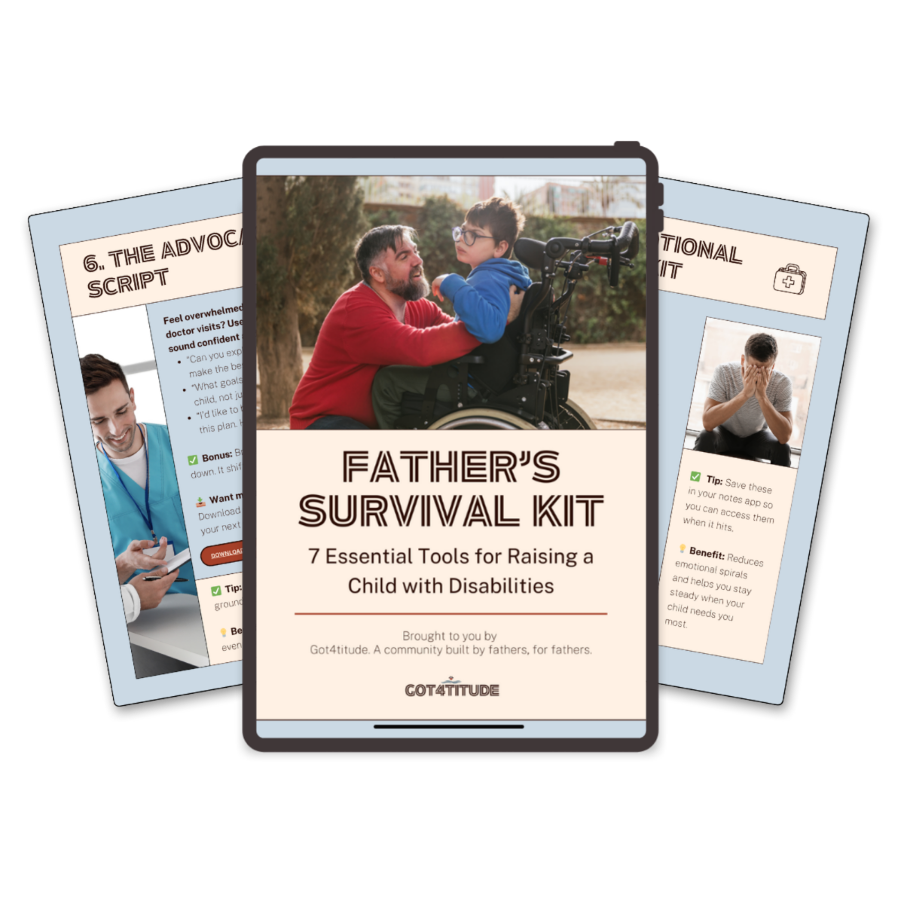
I’m grateful that the National Parents Union also believes in making real resources easy to find. You can now find the Father’s Survival Kit included on the National Parents Union Resource Page, so parents and caregivers can share it with the fathers in their lives without having to go searching.
Harley. And the reason I will not stop
Harley is the reason this mission is personal.
He is also the reason I believe in possibility.
A rare genetic disorder may be part of our story, but it is not the whole story.
Like so many of your children, Harley has taught me patience I did not know I had. Love that rewires your heart. A new definition of progress. A new definition of strength.
His diagnosis changed our lives.
It also revealed my calling.
An invitation to the parents reading this
If you are parenting a neurodivergent child, I see you.
And if you are doing it alongside a father who is carrying more than he knows how to say, this is your reminder.
Fathers need support too. Not someday. Now.
Because when dads get supported, moms get supported. Partnerships get supported. Siblings get supported. Children get supported.
That is how systems change. One family at a time, then a million at a time.
Support is how strong dads stay strong.
If you want to learn more about Got4titude, or you want to connect a father in your life to a community that understands, we are here.
Learn more: www.got4titude.com
Join the Inner Circle, where fathers come to thrive, not survive: got4titude.com/inner-circle
Kirby Rabalais is the founder of Got4titude®. Got4titude’s mission is to provide empathetic support, guidance, and resources to help fathers navigate this path with strength and resilience. Whether your child is newly diagnosed or you have been on this journey for years, we’re here to connect you with a community that understands. In addition to Got4titude®, Kirby serves on the Aspiritech Advisory Board, where he contributes his insights to support their incredible mission of creating meaningful employment and social opportunities for autistic adults. Kirby is an active member of NPU’s Parent Power Collective.